Pre-operational sanitation is the most underestimated yet decisive phase in the lifecycle of any pharmaceutical system. It represents the moment when a newly installed utility or manufacturing system transitions from being an engineered structure to becoming a GMP-relevant process element. Unlike routine cleaning, pre-operational sanitation is not about maintenance—it is about origin control.
A system that begins its life in a controlled hygienic state is inherently easier to validate, monitor, and maintain. A system that does not often carries invisible risks for years.
1. Why Pre-Operational Sanitation Is Non-Negotiable
In pharmaceutical manufacturing, water systems are not merely utilities; they are direct product-contact systems. A newly commissioned water purification system may look clean, shiny, and unused, yet internally it carries a hidden history of fabrication, transportation, storage, welding, and installation. Oils from machining, metal oxides from welding, dust, moisture, and environmental microorganisms are commonly present long before the first drop of purified water is generated.
Pre-operational sanitation is the bridge between installation and validation. It ensures that the system starts its lifecycle from a controlled microbiological and chemical baseline, rather than inheriting contamination that could later evolve into persistent biofilm.
2. Purpose and Regulatory Intent
The primary goal of pre-operational sanitation is to render the system fit for pharmaceutical use before qualification activities (IQ/OQ/PQ) begin. Regulatory agencies expect documented evidence that:
- Construction and installation residues have been removed
- Internal surfaces are chemically clean and microbiologically controlled
- The system can consistently support pharmacopeial water quality
This activity aligns with GMP principles, WHO guidance, EU GMP Annex 1, and USP <1231>, all of which emphasize proactive contamination control in water systems.
3. Foundational Principle – Cleaning Always Precedes Disinfection
A key scientific principle governs pre-operational sanitation:
Disinfectants are effective only on clean surfaces.
Organic residues, oils, and particulates can shield microorganisms, drastically reducing disinfectant efficacy. Therefore, sanitation is executed as a layered process, not a single step.
4. Structured Sanitation Strategy (Explained Sequentially)
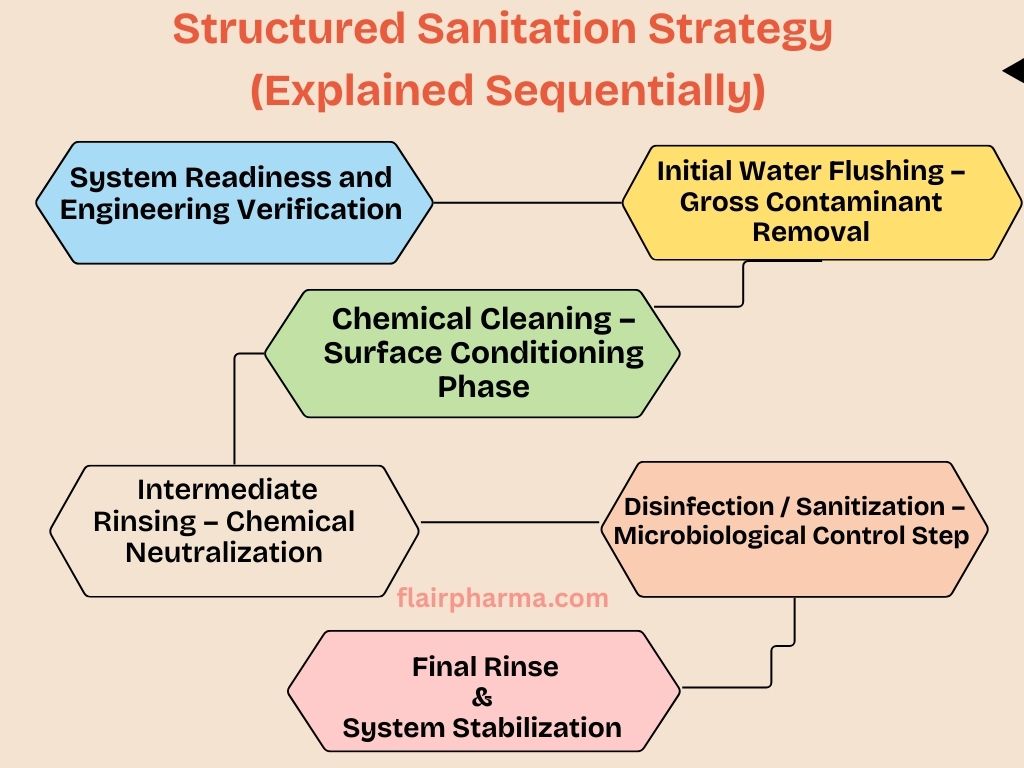
4.1 System Readiness and Engineering Verification
Before introducing any cleaning solution, the system is assessed for hygienic design compliance:
- Correct slopes for complete drainability
- Absence of stagnant zones and excessive dead legs
- Proper installation of valves, instruments, filters, and sampling points
This step ensures that all internal surfaces will receive adequate flow, contact time, and exposure during sanitation.
4.2 Initial Water Flushing – Gross Contaminant Removal
The system is flushed using potable or pre-treated water at turbulent flow rates. This step removes:
- Dust and loose particulates
- Preservatives used during storage
- Non-adhered fabrication residues
Although simple, this step significantly reduces the overall contaminant burden and prepares the system for effective chemical cleaning.
4.3 Chemical Cleaning – Surface Conditioning Phase
Chemical cleaning targets contaminants not visible to the eye. Depending on system design and materials:
- Alkaline cleaners dissolve oils, greases, and organic matter
- Acidic cleaners remove metal oxides, weld discoloration, and mineral scale
Critical parameters such as concentration, temperature, flow velocity, and contact time are controlled and documented. The intent here is not microbial kill but restoration of clean, reactive-free stainless-steel surfaces.
4.4 Intermediate Rinsing – Chemical Neutralization
Following chemical cleaning, the system is thoroughly rinsed using purified or demineralized water until:
- Conductivity returns to baseline
- pH normalizes
- No residual cleaning agent is detected
This step prevents chemical interactions with disinfectants and avoids potential corrosion or product contamination risks.
4.5 Disinfection / Sanitization – Microbiological Control Step
This phase establishes microbiological control across the entire system. Common approaches include:
- Thermal sanitization (hot water circulation at 70–80 °C)
- Chemical sanitization (ozone, peracetic acid, hydrogen peroxide, or chlorine-based agents)
Selection depends on material compatibility, system design, and intended routine sanitization strategy. The objective is to reduce microbial load to acceptable limits and suppress biofilm initiation.
4.6 Final Rinse and System Stabilization
After sanitization, residual disinfectants are removed by continuous circulation of purified water. The system is allowed to stabilize under normal operating conditions, enabling:
- Chemical equilibrium
- Temperature stabilization
- Baseline monitoring of microbial and chemical parameters
Only after stabilization is the system considered ready for qualification testing.
5. Summary Table – Pre-Operational Sanitation Logic

6. Documentation and Compliance Expectations
Regulatory acceptance depends not only on execution but also on traceable documentation, including:
- Approved SOPs and protocols
- Cleaning and sanitization records
- Chemical concentration and temperature logs
- Analytical results (conductivity, TOC, microbial counts)
- Deviations, investigations, and CAPA (if applicable)
These records form the foundation for successful audits and inspections.

Frequently asked questions:
What is meant by “pre-operational sanitation” in pharmaceuticals?
Pre-operational sanitation is the structured cleaning and disinfection activity performed after system installation but before qualification and routine use, aimed at establishing a controlled hygienic baseline rather than maintaining cleanliness.
Why is a newly installed system considered contaminated by default?
Because fabrication, welding, transportation, storage, and installation expose the system to oils, metal residues, dust, moisture, and environmental microorganisms—even if the system has never been used.
How does pre-operational sanitation differ from routine sanitization?
Pre-operational sanitation is a one-time foundational activity to establish cleanliness, whereas routine sanitization is a maintenance activity designed to preserve an already validated state.
What is the biggest risk of skipping pre-operational sanitation?
The early formation of biofilm, which can become deeply embedded and difficult to remove later, leading to chronic microbial failures.
Why must cleaning always be performed before disinfection?
Because organic residues and oils act as protective barriers, preventing disinfectants from effectively contacting and killing microorganisms.
What types of contaminants are targeted during chemical cleaning?
- Machining oils and lubricants
- Welding oxides and heat discoloration
- Construction residues
- Metallic fines and mineral deposits
Is pre-operational sanitation focused more on microbiology or chemistry?
Both—but chemistry comes first. Surface chemistry must be corrected before microbiological control can be effective.
Why is system drainability critical during pre-operational sanitation?
Poor drainability can trap cleaning agents or disinfectants, causing chemical carryover, corrosion, or localized contamination.
What role does flow velocity play in sanitation effectiveness?
Adequate velocity creates turbulence, ensuring uniform contact with internal surfaces and preventing stagnant zones.
Can potable water be used during pre-operational sanitation?
Yes, but typically only during initial flushing. Later stages require purified or demineralized water to avoid re-contamination.
What determines the choice of disinfectant?
- Material compatibility
- System design
- Regulatory expectations
- Intended routine sanitization strategy
- Microbial risk profile
Why is thermal sanitization often preferred for water systems?
Because it avoids chemical residues, penetrates biofilm more effectively, and is easier to validate for consistent microbial control.
What does “system stabilization” mean after sanitation?
Allowing the system to circulate under normal operating conditions until chemical and microbiological parameters reach equilibrium.
Is microbiological testing required immediately after sanitation?
Yes, to confirm that the sanitation process has successfully reduced microbial load and established a clean baseline.
Can pre-operational sanitation replace qualification testing?
No. It supports qualification but does not replace IQ, OQ, or PQ, which verify design, operation, and performance.
What documentation proves pre-operational sanitation was successful?
- Approved protocols and SOPs
- Cleaning and sanitization records
- Analytical test results
- Deviations and CAPA (if any)
How do regulators view pre-operational sanitation during inspections?
As evidence of proactive contamination control and GMP maturity rather than reactive problem-solving.
What happens if residues from cleaning agents remain in the system?
They may cause corrosion, interfere with analytical testing, or compromise product quality during manufacturing.
Why is pre-operational sanitation considered a “risk reduction tool”?
Because it eliminates contamination risks before they become operational or compliance issues.
How does pre-operational sanitation impact long-term system performance?
Systems that start clean typically require fewer sanitizations, experience fewer deviations, and remain compliant for longer periods.
Is pre-operational sanitation mandatory for all pharmaceutical systems?
Yes, for all product-contact or critical utility systems, especially water, clean steam, and process equipment.
Can poor pre-operational sanitation be corrected later?
It can be corrected, but often at higher cost, greater downtime, and increased regulatory scrutiny.
Why is pre-operational sanitation sometimes called “hygienic commissioning”?
Because it transforms an installed system into a hygienically controlled, GMP-ready asset.
What is the single most important outcome of pre-operational sanitation?
Establishing a clean, controlled, and reproducible starting point for qualification and routine pharmaceutical use.
How would you summarize pre-operational sanitation in one line?
It is the process that decides whether a pharmaceutical system starts its life in control—or spends its life fighting contamination.
PHARMACEUTICAL Pure Water Guide