
(Commonly Known as Smoke Study in Cleanroom Areas)
Airflow Visualization Studies (AVS) are qualitative yet powerful tools used in cleanroom environments to make invisible air movement visible. Instead of relying only on numerical airflow data, this study uses generated smoke or fog to visually demonstrate how air behaves around critical processing zones, equipment, operators, and materials.
In pharmaceutical sterile manufacturing, where product exposure equals product risk, understanding airflow is not optional—it is fundamental. These studies act as a visual audit of cleanroom design and operational discipline.
Why Airflow Visualization Is Critical in GMP Facilities
Cleanrooms are designed on the principle that air must always protect the product, not the operator or the equipment. AVS confirms whether this principle holds true in real operating conditions.
Key GMP Objectives Achieved:
- Verification of unidirectional airflow (UDAF)
- Detection of turbulence, dead zones, and reflux
- Assessment of operator interference
- Demonstration of contamination control strategy (CCS)
Scientific Basis – How the Study Actually Works
Airflow visualization relies on introducing a neutral, non-toxic aerosol into the airflow stream. The smoke particles follow air currents faithfully, allowing observers to track:
- Direction of air movement
- Velocity consistency
- Air recovery behavior
- Interaction with obstacles
The study is observational, but its implications are regulatory and risk-based.
When and Where These Studies Are Performed
Typical Cleanroom Locations:
- Grade A Laminar Airflow (LAF) units
- Isolators and RABS
- Filling lines and capping zones
- Sterile component transfer points
Lifecycle Stages:
- Cleanroom qualification (DQ/IQ/OQ/PQ)
- Aseptic process simulation (media fill)
- Facility modification or layout change
- Periodic requalification.
Classification of Airflow Visualization Techniques in Pharmaceutical Cleanrooms
Design-Intent Visualization (At-Rest Airflow Study)
Conceptual Explanation
This type of airflow visualization is performed when the cleanroom is fully installed but inactive—no operators, no materials, no process motion. The aim is to visually confirm whether the engineering design intention translates into real airflow behavior.
Here, smoke behaves like a “truth serum” for HVAC design. It shows whether HEPA-filtered air truly moves in a uniform, sweeping pattern, pushing contaminants away from critical zones.
What It Demonstrates
- Correct air supply and return alignment
- Uniform downward or horizontal flow
- Absence of stagnant pockets
Pharmaceutical Relevance
This study forms the baseline airflow fingerprint of the cleanroom and is essential during OQ and initial qualification.
Operational Airflow Visualization (Dynamic Study)
Conceptual Explanation
Dynamic airflow visualization studies replicate actual manufacturing conditions. Operators move, machines run, and materials are transferred. Smoke now interacts with human behavior, making this study far more revealing.
This type answers a critical question:
Does the cleanroom still protect the product when people are involved?
What It Demonstrates
- Impact of operator movement on airflow
- Turbulence caused by equipment geometry
- Product exposure vulnerability
Pharmaceutical Relevance
Highly emphasized during aseptic processing validation and regulatory inspections.
Critical Intervention Visualization
Conceptual Explanation
This study focuses exclusively on aseptic manipulations—the moments when the product is most vulnerable. Smoke is introduced while interventions such as stopper loading, filling needle adjustments, or component transfers occur.
The airflow here must shield the product, even during the most intrusive actions.
What It Demonstrates
- Airflow robustness during worst-case actions
- Directional protection over open containers
- Absence of reflux from non-critical zones
Pharmaceutical Relevance
Directly linked to media fill justification and contamination risk assessments.
Personnel-Influence Visualization
Conceptual Explanation
In this type, smoke is used to study how human presence alters airflow patterns. The human body generates heat, acts as an obstruction, and creates micro-turbulence that can disturb unidirectional airflow.
This study proves that operator discipline is as important as cleanroom design.
What It Demonstrates
- Airflow deflection caused by operator posture
- Effect of arm movements and leaning
- Proper positioning relative to Grade A zones
Pharmaceutical Relevance
Supports aseptic technique training and gowning qualification
Equipment Interaction Visualization
Conceptual Explanation
Here, airflow visualization is targeted around machines, tools, and fixtures. Even well-designed equipment can create air shadows, turbulence, or reverse flows if not properly placed.
Smoke reveals whether equipment is a protector or a contaminant trap.
What It Demonstrates
- Airflow obstruction zones
- Wake effects behind equipment
- Suitability of equipment design for aseptic use
Pharmaceutical Relevance
Used during equipment qualification (DQ/OQ) and line modifications.
Cleanroom Recovery Visualization
Conceptual Explanation
This study evaluates how quickly the cleanroom returns to a controlled state after a disturbance such as door opening, material transfer, or personnel exit.
Smoke is released and the time taken for it to be fully cleared is visually assessed.
What It Demonstrates
- Air change effectiveness
- Cleanroom recovery capability
- HVAC responsiveness
Pharmaceutical Relevance
Supports cleanroom classification compliance and HVAC validation.
Failure-Mode or Worst-Case Visualization
Conceptual Explanation
This is a deliberately stressful study where airflow is challenged—maximum operators, peak activity, and high material movement. Smoke is used to expose vulnerabilities that may not appear under normal conditions.
What It Demonstrates
- System limits
- Contamination risk thresholds
- Need for procedural or design CAPAs
Pharmaceutical Relevance
Strongly aligned with Quality Risk Management (ICH Q9) principles.
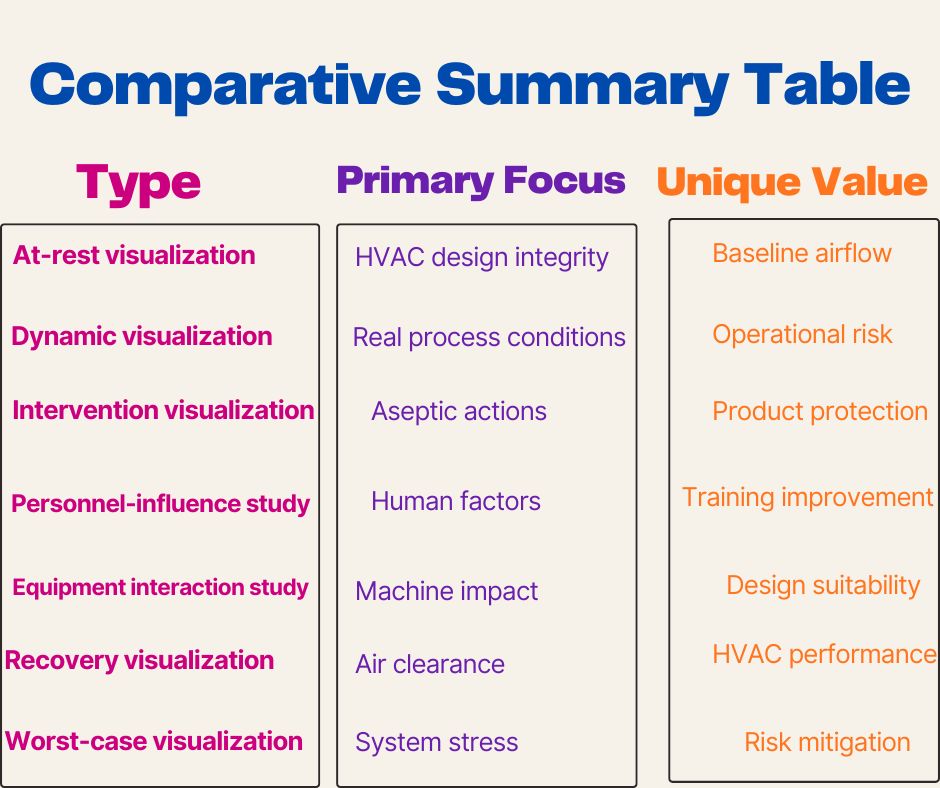
Comparative Summary Table
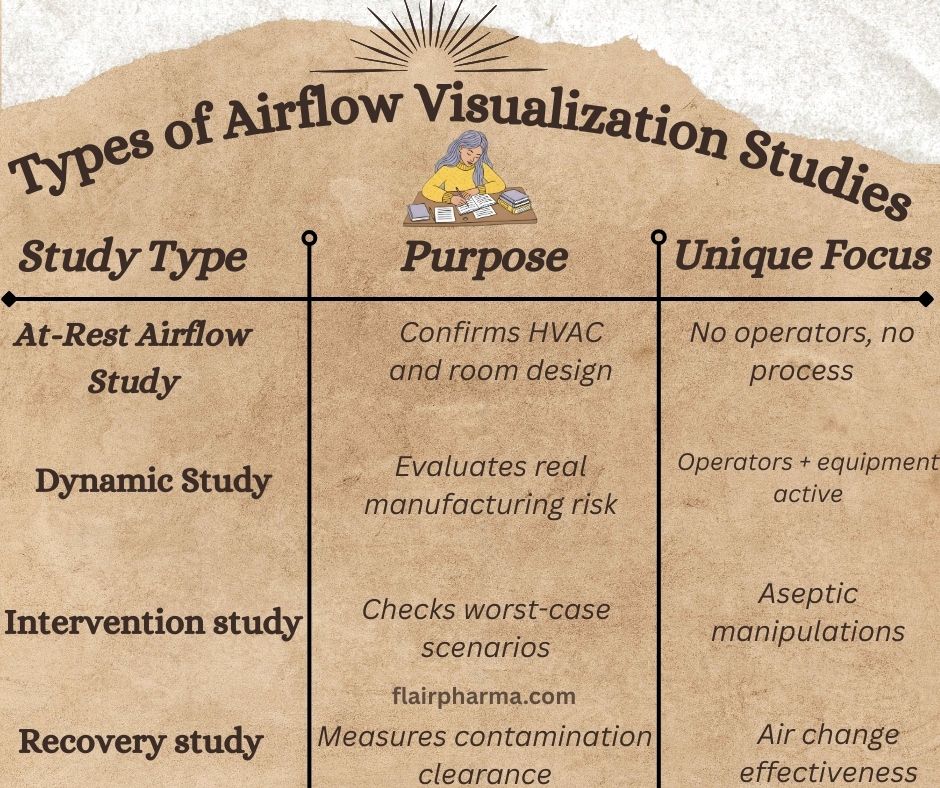
Types of Airflow Visualization Studies:
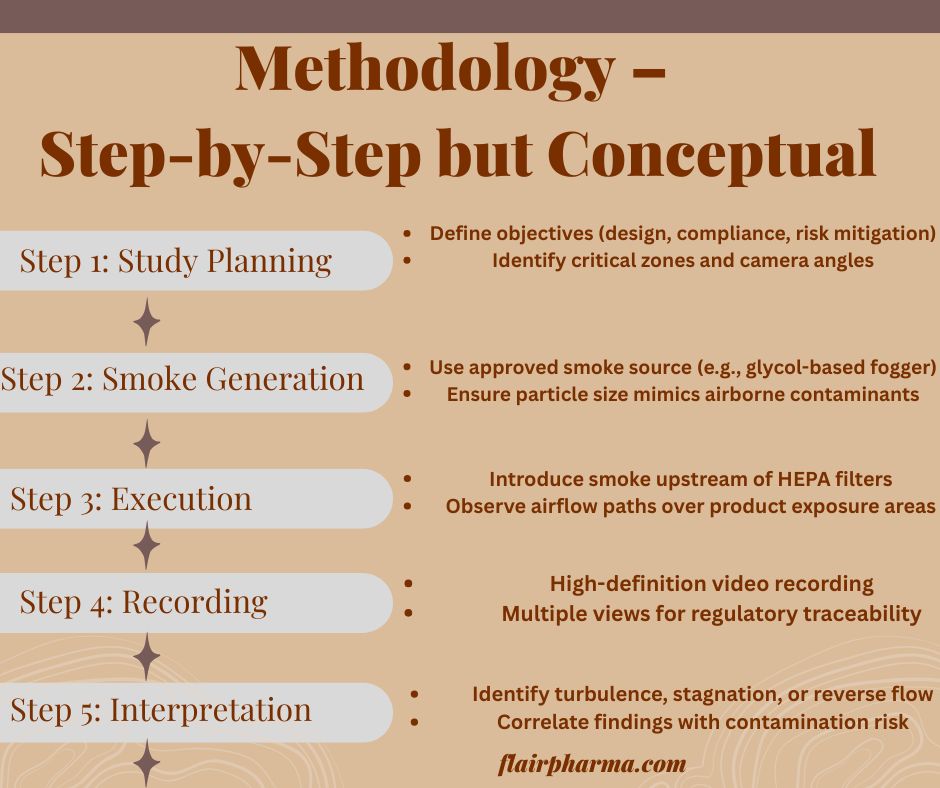
Methodology – Step-by-Step but Conceptual:
Common Observations and Their Meaning:
| Observation | What It Indicates | Risk Level |
|---|---|---|
| Smooth vertical flow | Proper unidirectional airflow | Low |
| Swirling smoke | Turbulence due to obstruction | Medium |
| Smoke rising upward | Reverse airflow | High |
| Smoke lingering | Poor air recovery | Medium–High |
Regulatory Expectations :
Regulators expect airflow visualization to:
- Be video-documented
- Reflect worst-case operations
- Be repeated periodically
- Be integrated into the Contamination Control Strategy
These studies are often reviewed during USFDA, EMA, and WHO inspections, especially for sterile manufacturing facilities.
Common Failures Identified Through Visualization:
- Incorrect operator positioning
- Poorly designed equipment geometry
- Inadequate HEPA coverage
- Excessive material movement
- Misplaced return air grilles
Many facilities discover that design-compliant cleanrooms fail operationally, which makes AVS invaluable.
Documentation and GMP Linkage:
A complete airflow visualization package typically includes:
- Approved protocol
- Risk assessment
- Video recordings
- Observation summary
- Deviation reports (if any)
- CAPA and effectiveness checks
This documentation bridges engineering controls with quality assurance.
Frequently asked questions:
Why is airflow visualization considered a qualitative study despite its critical importance?
Because it visually demonstrates airflow behavior rather than producing numerical values. However, its qualitative nature does not reduce its importance—regulators rely on visual evidence to confirm whether airflow truly protects critical product exposure areas.
How does airflow visualization support the contamination control strategy (CCS)?
It provides direct evidence that airflow design, operator behavior, and equipment placement collectively prevent contamination, thereby validating key assumptions within the CCS.
What makes dynamic airflow visualization more critical than at-rest studies?
Dynamic studies simulate real manufacturing conditions, revealing airflow disturbances caused by operators, equipment motion, and interventions—risks that at-rest studies cannot expose.
Why is smoke introduced upstream of HEPA filters during studies?
Introducing smoke upstream ensures that airflow patterns observed represent the true direction and uniformity of HEPA-filtered air, not artificially induced turbulence.
What does lingering smoke in a Grade A zone indicate?
It indicates poor air sweep or inadequate air changes, which increases the risk of particulate and microbial contamination.
How does operator posture affect airflow patterns?
Leaning, overreaching, or incorrect hand positioning can block unidirectional airflow and cause reflux, allowing contaminants from lower-grade areas to migrate into critical zones.
Why are interventions always included in airflow visualization studies?
Interventions represent the highest contamination risk moments; airflow must consistently protect the product even during these worst-case manipulations.
What is meant by “airflow shadowing” around equipment?
It refers to zones behind or beneath equipment where airflow becomes weak or stagnant, potentially allowing particles to accumulate.
How do recovery airflow visualization studies differ from normal studies?
Recovery studies focus on how quickly airborne smoke is cleared after a disturbance, demonstrating HVAC responsiveness rather than steady-state airflow behavior.
Can airflow visualization replace air velocity measurements?
No. Both are complementary—velocity confirms compliance with specifications, while visualization confirms airflow effectiveness and direction.
Why is video recording mandatory for airflow visualization?
Videos provide objective, reviewable evidence for regulators, auditors, and internal quality reviews, ensuring transparency and traceability.
What risks are revealed only during worst-case airflow visualization?
Maximum personnel load, simultaneous interventions, and high material movement can expose airflow breakdowns not visible during routine operations.
How often should airflow visualization be repeated?
During initial qualification, after significant changes, periodically as per SOPs, and whenever contamination risks increase or trends are observed.
Why is airflow visualization critical during media fill simulations?
It visually confirms that airflow protects open containers during the same interventions simulated in media fills, strengthening sterility assurance justification.
What does upward smoke movement in a Grade A area signify?
Reverse airflow, which is a serious GMP concern indicating loss of unidirectional airflow control.
How does human heat load influence airflow behavior?
A: Body heat creates thermal plumes that can lift particles upward, disrupting downward unidirectional airflow if not properly managed.
Why must airflow visualization reflect “worst realistic conditions”?
Regulators expect evidence that contamination control remains effective under the most challenging yet plausible operational scenarios.
What documentation supports an airflow visualization study?
A: Approved protocols, risk assessments, videos, observation reports, deviations, CAPA records, and effectiveness checks.
Can airflow visualization identify poor cleanroom design early?
Yes. It often exposes design flaws such as incorrect return air placement, inadequate HEPA coverage, or unsuitable equipment geometry.
Why is airflow visualization often reviewed during regulatory inspections?
Because it provides intuitive, visual proof of contamination control, allowing inspectors to quickly assess aseptic robustness.
What role does airflow visualization play in aseptic technique training?
It visually educates operators on how their movements affect airflow, reinforcing correct behavior through observation rather than theory.
How does airflow visualization support deviation investigations?
It helps determine whether airflow disturbances may have contributed to contamination events or environmental monitoring excursions.
Why must smoke particles be non-toxic and residue-free?
To avoid product contamination, equipment damage, and false conclusions due to particle settling or chemical residues.
What is the biggest misconception about airflow visualization?
That passing once guarantees permanent compliance; in reality, airflow performance can degrade due to changes in behavior, layout, or maintenance.
How does airflow visualization strengthen sterility assurance?
By converting invisible airflow assumptions into visible, defensible evidence that the product is continuously protected.