Microbiological Analysis in Cleaning Method Validation is more than a cleaning task—it is a critical quality assurance practice that defines the purity, safety, and credibility of every product leaving the production floor. Yet, beyond residues and chemical traces lies another, quieter threat: microbial contamination.
This is where microbiological analysis becomes the invisible detective—uncovering what the eye cannot see, and confirming that cleanliness is not only visible, but verifiable.
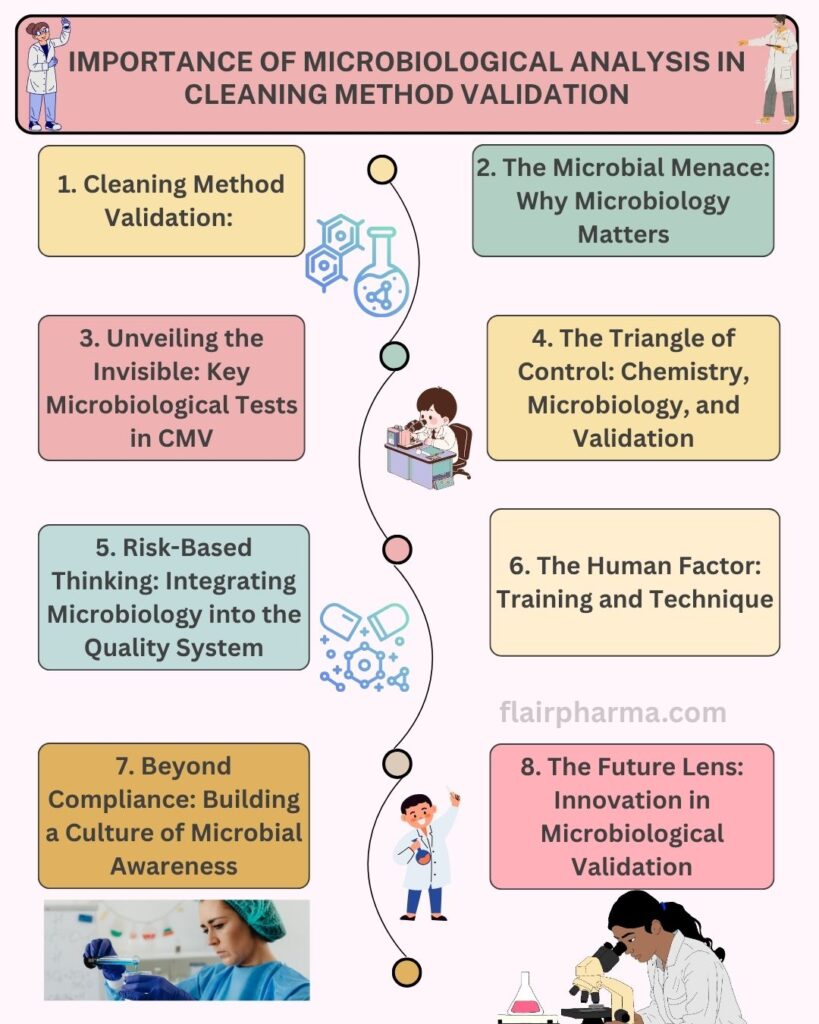
1. Cleaning Method Validation: The Science of Assurance
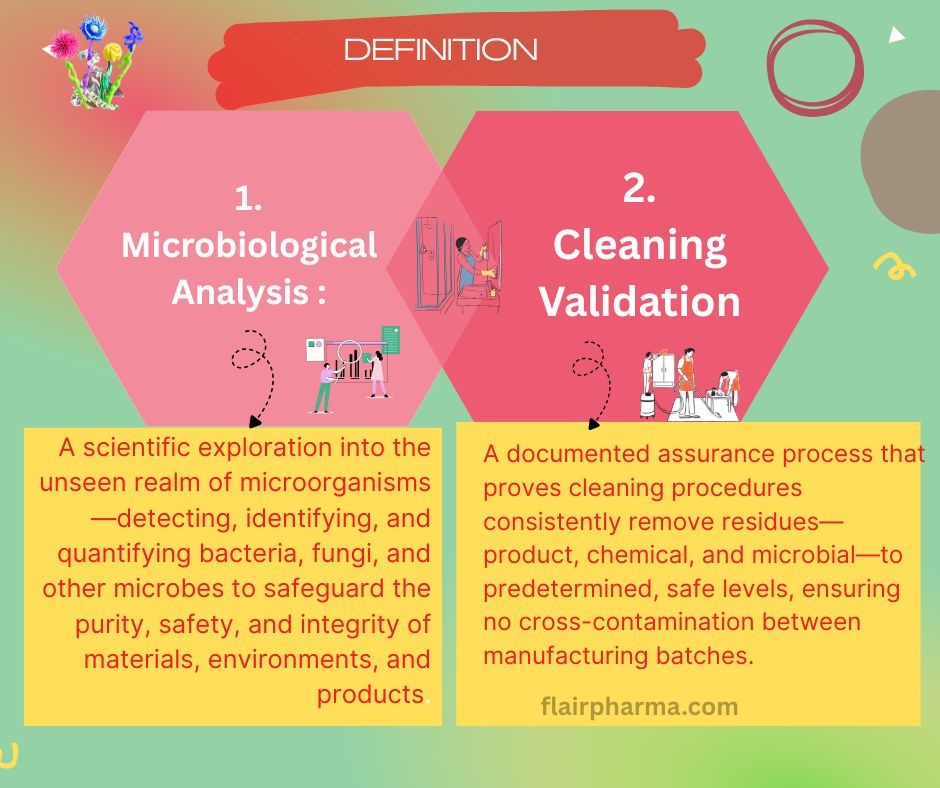
Cleaning method validation (CMV) is a formal process to prove that the cleaning procedure effectively removes all residues—chemical, product, and microbial—to acceptable levels.
While chemical residue testing ensures the absence of cross-contamination, microbiological analysis confirms the absence of life where life should not exist.
It answers the question:
“Has the process truly removed every trace of viable microorganisms that could threaten product integrity?”
Without microbiological validation, cleaning would be half-proven—like checking that a knife is polished but ignoring if it’s sterile.
2. The Microbial Menace: Why Microbiology Matters
Microorganisms are master survivors. They can colonize surfaces, form biofilms, and endure harsh environments—especially in equipment used for non-sterile manufacturing.
If undetected, these microbes can:
- Multiply in moist or nutrient-rich residues
- Spoil products or alter their stability
- Endanger patient safety
- Cause batch rejections and costly investigations
Thus, microbiological analysis is not a luxury—it is a necessity. It ensures that every cleaned surface is truly free from viable contamination, not just visibly clean.
3. Unveiling the Invisible: Key Microbiological Tests in CMV
To verify microbiological cleanliness, several analytical tools come into play:
- Total Viable Count (TVC): Measures the number of living microorganisms remaining on cleaned surfaces.
- Surface Swab Testing: Directly samples contact surfaces of equipment post-cleaning.
- Rinse Sampling: Examines the rinse water from the final cleaning stage for microbial presence.
- Endotoxin Testing: Especially crucial for parenteral products; detects bacterial toxins even after cells are destroyed.
These analyses form a microscopic audit—confirming that microbial risks are reduced to a scientifically acceptable threshold.
4. The Triangle of Control: Chemistry, Microbiology, and Validation
Cleaning validation stands on three pillars:
- Chemical Cleanliness – ensuring no residual actives, detergents, or excipients.
- Microbiological Cleanliness – ensuring no viable microorganisms remain.
- Procedural Validation – ensuring the cleaning method is repeatable and effective under routine conditions.
Microbiological analysis forms the biological conscience of this triangle—reminding us that chemical purity alone does not equal safety.
5. Risk-Based Thinking: Integrating Microbiology into the Quality System
A strong microbiological validation strategy aligns with Quality Risk Management (QRM) principles under ICH Q9 and WHO guidelines.
This involves:
- Identifying potential sources of microbial contamination (water systems, personnel, environment).
- Establishing alert and action limits based on baseline data.
- Trending microbial results over time to detect early warning signals.
Such integration transforms microbiological testing from a compliance checkbox into a predictive control tool—capable of preventing contamination before it occurs.
6. The Human Factor: Training and Technique
Even the most advanced analysis is only as reliable as the hands that perform it.
Consistent training in aseptic sampling, handling, and testing is vital. Microbiologists and cleaning operators must share a common understanding that cleaning is not about removing dirt—it’s about eliminating doubt.
In this sense, microbiological validation becomes a shared responsibility between quality assurance, microbiology, and production teams.
7. Beyond Compliance: Building a Culture of Microbial Awareness
Regulatory agencies like the FDA, EMA, and WHO emphasize microbiological monitoring as a cornerstone of Good Manufacturing Practice (GMP).
However, true excellence goes beyond meeting requirements—it involves cultivating a culture of microbial mindfulness, where every technician, cleaner, and engineer recognizes the silent power of microorganisms and the importance of controlling them.
8. The Future Lens: Innovation in Microbiological Validation
Emerging technologies are redefining how we detect and control microbes:
- Rapid Microbiological Methods (RMMs): Deliver near real-time results, reducing downtime between cleaning and production.
- ATP Bioluminescence Testing: Provides quick on-site verification of cleaning effectiveness.
- Automation and AI-Based Monitoring: Analyze microbial trends and predict contamination risks with greater accuracy.
These advancements make microbiological analysis faster, smarter, and more integrated with modern pharmaceutical workflows.
Conclusion: Clean Beyond the Surface
In the pharmaceutical universe, microbiological analysis in cleaning validation is not just about meeting limits—it’s about proving purity at the microbial level. It bridges the visible and the invisible, the mechanical and the biological, ensuring that every surface, tank, and pipe is truly ready to produce safe medicines.
When science, vigilance, and validation unite, cleanliness evolves from a procedure into a promise—a promise that what heals will never harm.
Frequently asked questions (FAQ):
Why is microbiological analysis important?
Because it safeguards life by detecting invisible threats—ensuring that products, water, and environments remain safe, sterile, and compliant with health standards.
What is the MACO value in cleaning validation?
MACO (Maximum Allowable Carryover) is the scientific threshold that defines how much residue from one product can safely remain without contaminating the next.
What are the microbial limits for cleaning validation?
Microbial limits are pre-set numerical boundaries (e.g., <100 CFU/swab) that confirm cleaned surfaces or equipment meet microbial safety requirements.
What is the importance of microbiological assay?
It quantifies the biological activity of a substance—revealing potency, purity, and consistency through microbial response rather than mere chemistry.
What are the five importance s of microbiology?
It drives medicine (antibiotics), food safety, environmental balance, biotechnology innovation, and understanding of infectious diseases.
What are the methods of microbiological analysis?
Techniques include plate count, membrane filtration, microscopy, ATP bioluminescence, and molecular methods like PCR and sequencing.
What is the 21 CFR guideline for cleaning validation?
21 CFR Part 211 (FDA) mandates that cleaning procedures be validated to prove they consistently prevent contamination and ensure product quality.
What are the 7 steps in the cleaning process?
Pre-rinse → Detergent application → Scrubbing → Rinsing → Sanitizing → Final rinse → Drying and verification.
What is 10 ppm in cleaning validation?
It represents a residue level where only 10 parts per million of the previous product are permitted in the next batch—ensuring ultra-low contamination risk.
What are the critical parameters of cleaning validation?
Parameters include residue limits, swab recovery efficiency, rinse volume, cleaning agent type, temperature, contact time, and equipment surface area.
What are the 4 stages of cleaning?
Pre-cleaning, main cleaning, rinsing, and disinfection—each building toward complete removal of physical and microbial contaminants.
What is the ICH Q7 guideline?
ICH Q7 provides GMP guidance for active pharmaceutical ingredient (API) manufacturing, emphasizing validation, documentation, and contamination control.
What is the main purpose of microbiology?
To understand microscopic life and harness or control it—balancing the power of microbes for health, industry, and ecology.
What are the four types of microbiology?
Medical, environmental, industrial, and food microbiology—each exploring microbial influence in different domains.
What is the 10 importance of bacteria?
Bacteria recycle nutrients, fix nitrogen, decompose waste, aid digestion, produce antibiotics, ferment food, support immunity, generate energy, detoxify environments, and balance ecosystems.
Why is microbial analysis important?
It ensures that products, air, and water are free from harmful microorganisms—protecting quality and consumer safety.
How to validate microbiology methods?
By testing parameters like accuracy, precision, specificity, robustness, detection limits, and reproducibility using reference microorganisms.
What is a microbiological analysis?
It’s the systematic examination of samples to detect, count, and identify microorganisms—ensuring purity and compliance.
What is the purpose of a microbiological test?
To confirm that products or environments are microbiologically safe, stable, and suitable for their intended use.
What are the 5 basic microbiology?
Bacteriology, Mycology, Virology, Parasitology, and Immunology—each studying a unique microbial kingdom or defense mechanism.
What are the 7 types of microorganisms studied in microbiology?
Bacteria, viruses, fungi, protozoa, algae, archaea, and prions—each with distinct structures and roles in nature.
How to perform microbial analysis?
Collect the sample aseptically, culture on suitable media, incubate under controlled conditions, identify colonies, and interpret counts.
Why is microbiological analysis of water important?
It ensures water used for drinking or manufacturing is free from pathogens and meets microbial quality standards.
What are the three methods of microbial identification?
Phenotypic (morphology & biochemistry), genotypic (DNA-based), and proteotypic (mass spectrometry or protein profiling).
What is the microbial limit in cleaning validation?
A pre-defined maximum microbial count (e.g., <100 CFU/25 cm²) that validates cleanliness and sterility assurance.
How to calculate MACO value in cleaning validation?
Using the formula: MACO=(TDDprevious×Mnext)(TDDnext×SF)MACO = \frac{(TDD_{previous} \times M_{next})}{(TDD_{next} \times SF)}MACO=(TDDnext×SF)(TDDprevious×Mnext)
Where TDD = therapeutic dose, M = batch size, SF = safety factor.
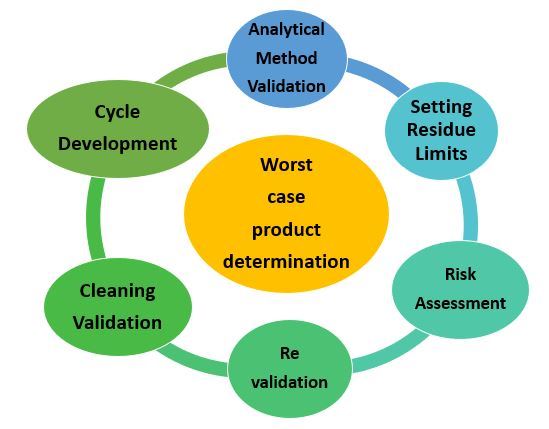
Why is cleaning validation important?
It confirms that cleaning methods consistently prevent contamination, ensuring product integrity and regulatory compliance.
What are the 4 pillars of cleaning?
Chemical action, mechanical action, temperature, and time—the four interdependent forces behind effective cleaning.
What are the five methods of cleaning?
Manual cleaning, CIP (Clean-in-Place), COP (Clean-out-of-Place), ultrasonic cleaning, and automated spray cleaning.
What are the three main components of cleaning?
The cleaning agent, mechanical action, and rinsing medium—each essential to residue removal.
What are the three main types of cleaning?
Preventive, routine, and corrective cleaning—addressing different contamination levels and frequencies.
What is the 5 things method for cleaning?
Sort, Set in order, Shine, Standardize, and Sustain—adapted from the 5S lean approach to maintain consistent hygiene.
What are the 5 steps in cleaning?
Pre-rinse, detergent cleaning, rinse, sanitization, and validation—forming a complete cleaning cycle.
Why 3 batches for validation?
Testing three consecutive successful batches demonstrates process consistency and reproducibility under routine conditions.
What is ISO validation of microbiological methods?
It aligns testing practices with ISO 17025 and ISO 11133 standards, ensuring traceability, reliability, and international acceptance.
What are the 8 steps of method validation?
- Specificity
- Linearity
- Accuracy
- Precision
- Range
- Detection limit
- Quantitation limit
- Robustness — all proving the method’s scientific reliability.