
Sterile Active Pharmaceutical Ingredient (API) manufacturing is a world where invisible microbes are the enemy, aseptic discipline is the shield, and process integrity is the battlefield. The Media Fill Test (MFT)—often called Aseptic Process Simulation (APS)—is the ultimate “dress rehearsal,” designed to prove that a sterile manufacturing line can function flawlessly before a real API batch is ever produced. Think of it as a microbiological fire drill, ensuring that when real contaminants try to invade, the system is ready.
What is a Media Fill Test?
Imagine replacing your highly valuable sterile API solution with a harmless nutrient broth—Tryptic Soy Broth (TSB)—that acts like a detective. Its job?
To travel through the entire aseptic processing chain, peeking into every corner, finding weaknesses, and reporting where microbial intruders might hide.
A Media Fill Test replicates exact manufacturing conditions: same machines, same operators, same environments, same duration, same interventions—but instead of drug solution, the broth is filled, transferred, filtered, and packed.
If microbes grow, the broth “snitches” and turns cloudy.
If it stays clean… the aseptic process passes the test.
Why is Media Fill Critical in Sterile API Manufacturing?
Sterile bulk drug substances undergo steps such as aseptic crystallization, sterile filtration, aseptic centrifuges, sterile dryers, and filling into sterile containers. Every touchpoint is a potential contamination doorway.
Media Fill is the only test that confirms:
- The people are following aseptic technique
- The equipment is not introducing contamination
- The interventions (filter changes, sampling, line stoppage) don’t break sterility
- The environmental controls like HVAC and cleanroom functionality are protective
- The process flow itself is inherently aseptic-capable
In short, MFT validates the sterility assurance level (SAL) of the whole manufacturing process—not by theory, but by real simulation.
Core Components of a Media Fill Test :
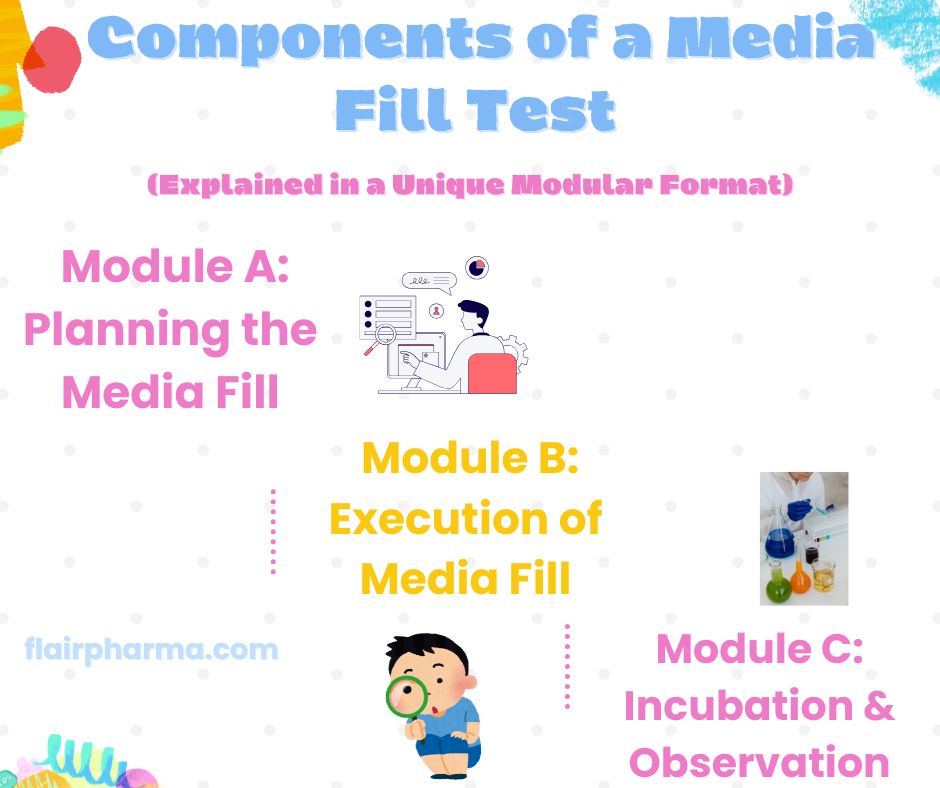
Module A: Planning the Media Fill:

Module B: Execution of Media Fill:
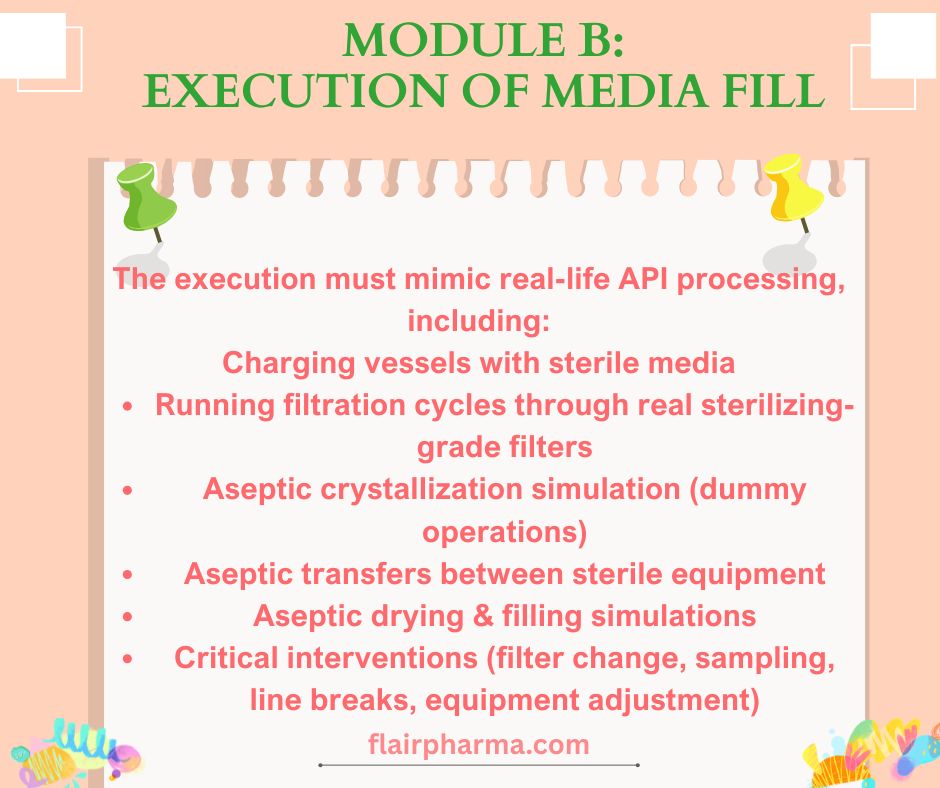
The goal is simple:
“If contamination can happen here, the media will catch it.”
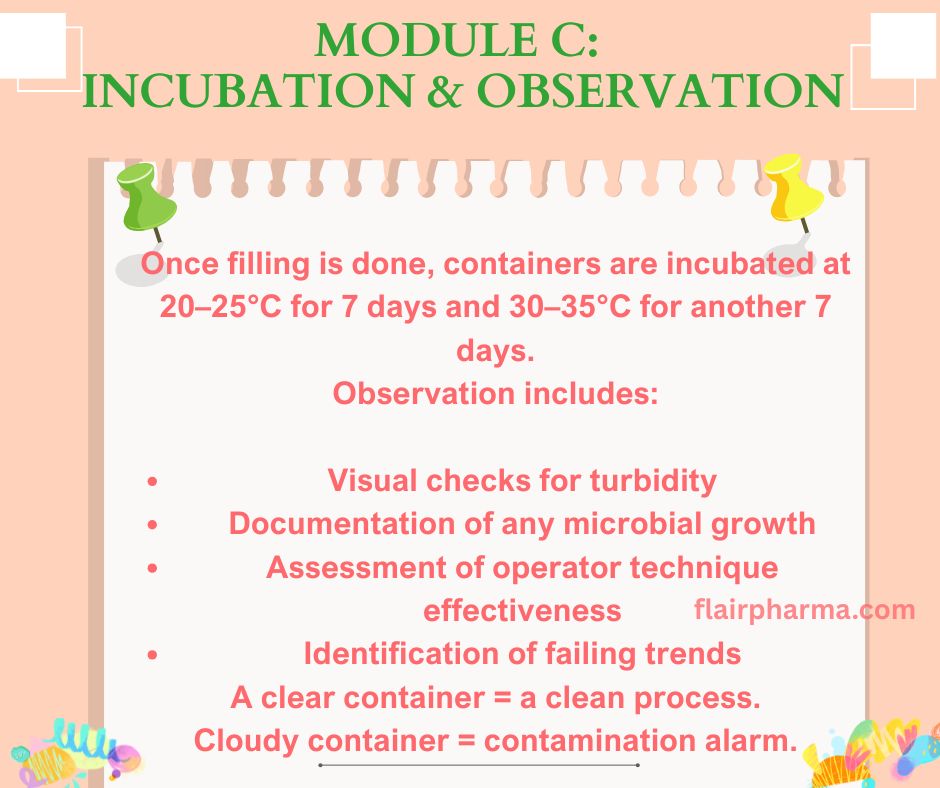
Module C: Incubation & Observation:
Acceptance Criteria (Explained as a Quick Reality Check):
Regulators like USFDA, EMA, and WHO give strict criteria:
- 0 contaminated units out of 5,000 or fewer filled units
- For 5,000–10,000 units, contamination ≤1 but must still be investigated
- No microbial trends, no cluster contamination
- End-to-end sterility assurance must be proven
In sterile API facilities where bulk volumes are high, criteria are even tighter due to downstream impact.
Challenges in Sterile API Media Fills :
Human Interventions
Most contamination arises from operators breaking aseptic barriers.
Complex Equipment Flow
Sterile centrifuges, glove ports, dryers, and reactors increase contamination risk.
Environmental Instability
Small deviations in pressure, temperature, or airflow can invite contaminants.
Ineffective Cleaning/Sterilization
Residues, biofilms, or sterilizer downtime can compromise sterility.
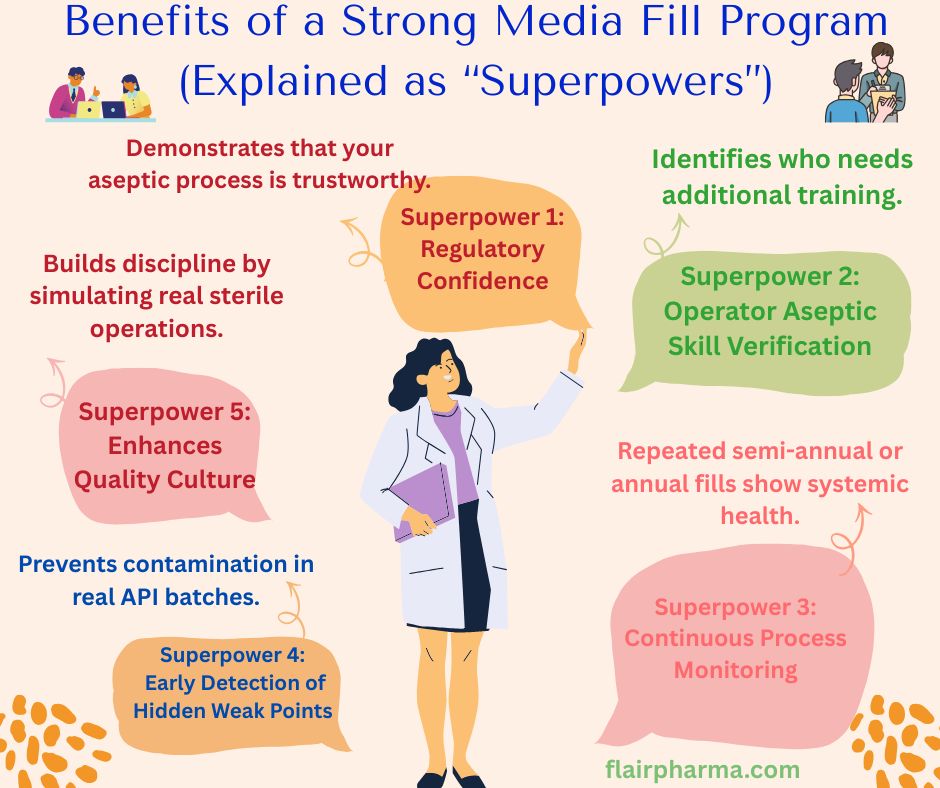
Benefits of a Strong Media Fill Program
“Comparison of Sterile API Media Fill vs. Sterile Finished Product Media Fill”
| Parameter | Sterile API MFT | Sterile Finished Product MFT |
|---|---|---|
| Process Complexity | Very High (crystallization + filtration) | Medium (mostly filling) |
| Exposure Points | Multiple vessel transfers | Mostly filling needles |
| Interventions | More manual | Mostly machine-based |
| Hold Time Simulation | Critical | Moderate |
| Equipment Sterilization Load | High (large tanks, reactors) | Lower (small systems) |
| Scale | Large volumes | Smaller fill volumes |
| Risk Level | Higher | Lower |
Top 5 Problems in sterile pharmaceutical manufacturing
Frequently asked questions (FAQ):
What is a Media Fill Test in sterile API manufacturing?
A: It is a full-scale simulation of aseptic API production using growth media (e.g., TSB) instead of actual product, designed to prove that the entire process—from filtration to filling—can operate without introducing microbial contamination.
Why is Media Fill considered the “microbial truth test”?
A: Because unlike theoretical validation, the broth will visibly reveal contamination through turbidity—making it an undeniable indicator of aseptic integrity.
How does Media Fill apply to sterile API processing specifically?
A: It replicates aseptic crystallization, sterile filtration, and aseptic transfers used for APIs, ensuring that complex bulk operations remain contamination-free at every step.
What type of media is commonly used? Why?
A: Tryptic Soy Broth (TSB), because it is a nutrient-rich medium capable of supporting wide-spectrum microbial growth, making it ideal for detecting low-level contamination.
What regulatory guidelines govern Media Fills?
A: USFDA, EMA Annex 1, PIC/S, WHO technical reports, and ISO cleanroom guidance—all demanding robust aseptic simulations twice yearly.
What is the primary objective of a Media Fill Test?
A: To provide documented proof that operators + equipment + environment + process flow can maintain sterility under worst-case and routine conditions.
How often must Media Fill be performed?
A: Typically semi-annually for each aseptic line or major aseptic unit, or after any critical changes or extended shutdowns.
What is a “worst-case condition” in Media Fills?
A: The condition where contamination is most likely: longest run time, maximum interventions, highest operator fatigue, slowest filling speeds, or difficult manipulations.
What are “interventions” in Media Fill?
A: Deliberate actions that mimic real operations like adjusting equipment, performing sampling, changing filters, or stopping and restarting processes—each a contamination risk point.
Why is operator technique critical in Media Fills?
A: Studies show 90% of aseptic contamination originates from human handling errors; Media Fill exposes these hidden weaknesses.
What is the acceptance criterion for Media Fill?
A: Zero contaminated units in ≤5,000 filled units. For larger samples, ≤0.1% contamination is acceptable—but any contamination still requires investigation.
Why do sterile API facilities require larger-scale Media Fills?
A: Bulk API processes involve larger vessels, open transfers, and filtration systems, increasing risk exposure; hence, simulation volume must mirror actual production scale.
What does turbidity indicate?
A: Microbial growth. The presence of even a single cloudy container signals process failure or aseptic breach.
What incubation regime is typically followed?
A: Dual temperature:
- 20–25°C for 7 days (fungi + psychrophiles)
- 30–35°C for 7 days (mesophiles + common bacteria)
What is a “line requalification” Media Fill?
A: A media fill conducted after major repairs or modifications—e.g., replacing sterilizing filters, revising equipment design, or changing critical SOPs.
What is the role of environmental monitoring during Media Fill?
A: To ensure that the cleanroom maintains the required ISO class and microbial levels while operators perform high-risk interventions.
Why is Media Fill important before launching a new sterile API product?
A: It confirms that the manufacturing design is robust enough to ensure sterility assurance, reducing risk of recalls or batch failures.
What is a “simulation of aseptic filtration”?
A: Passing sterile media through the same 0.22 μm filters used for APIs to evaluate filter integrity and aseptic handling.
How does Media Fill test equipment design?
A: Poorly designed equipment will introduce contamination during operation; Media Fill exposes these design flaws by forcing the system to operate under realistic stress.
How do operators prepare for Media Fill?
A: Training in aseptic technique, gowning validation, hand movement discipline, and awareness of contamination-prone actions.
What happens if Media Fill fails?
A: Production stops, root-cause analysis begins, and actions such as retraining, redesign, or process modification must be completed before re-performing the fill.
What is “container closure integrity assessment” in Media Fill?
A: Ensuring that sterile API containers (bags, bottles, drums) are sealed properly; otherwise, false positives may occur due to post-fill contamination.
Can Media Fill detect sporadic contamination?
A: Yes—because thousands of units are simulated, it amplifies any rare contamination event into visible microbial growth.
How is Media Fill documented?
A: Through a protocol and report covering risk assessment, simulation plan, interventions, observations, incubation logs, deviations, and conclusions.
Why is the media visually inspected twice?
A: To reduce observer bias—initial inspection and a confirmatory check ensure no turbidity is missed.
What is “media fill hold time”?
A: Broth may be kept in vessels or filters for extended periods to test worst-case microbial growth conditions, such as long residence times of APIs.
Can Media Fill be automated?
A: Although equipment can be automated, human interventions must always be simulated manually since human error remains the greatest contamination risk.
Why is Media Fill considered a validation of “aseptic culture”?
A: Because it measures not just sterility of equipment—but the discipline, awareness, and mindset of the entire aseptic workforce.
What is the difference between Media Fill and Sterility Test?
A:
- Media Fill: Validates process capability.
- Sterility Test: Evaluates final product sterility after manufacturing.
Media Fill is proactive; sterility tests are reactive.
Why is Media Fill indispensable in sterile API manufacturing?
A: Because APIs are the active backbone of drug products—any compromise in sterility can endanger patients and destroy product integrity.
Media Fill is the only simulation that ensures zero tolerance for contamination.