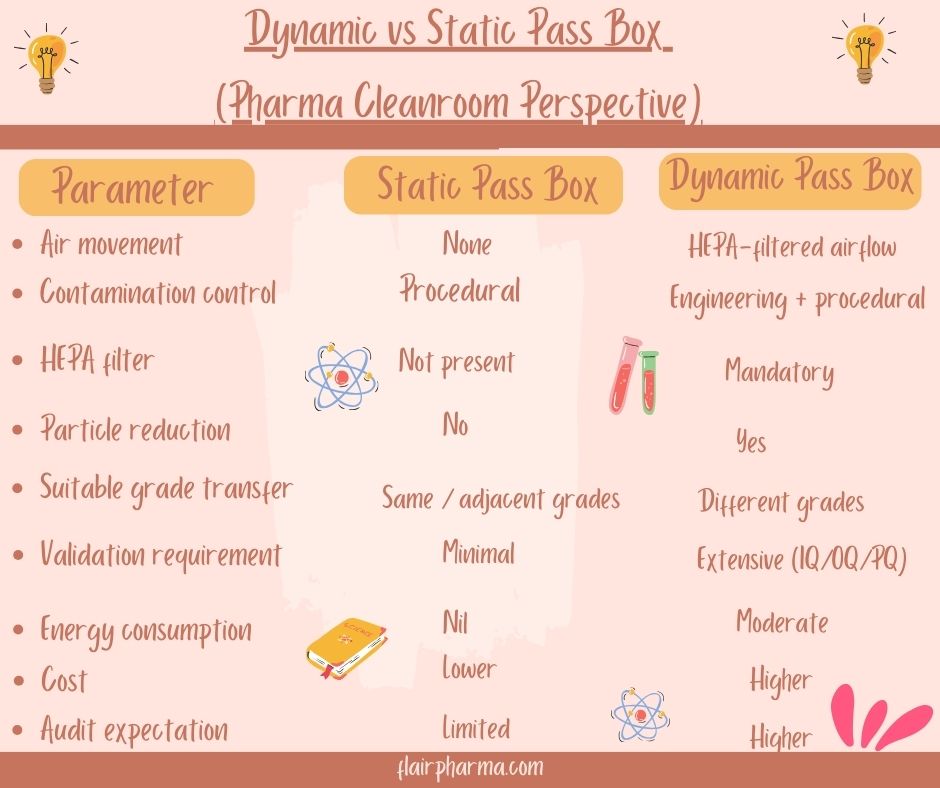
#1. Which feature fundamentally converts a pass box from “static” to “dynamic”?
#2. A static pass box primarily depends on which factor to control contamination?
#3. Dynamic pass boxes are classified as “active systems” because they:
#4. Which component is completely absent in a static pass box?
#5. The main objective of a dynamic pass box is to:
#6. Which airflow pattern is associated with dynamic pass boxes?
#7. Static pass boxes are best described as:
#8. Which design element is common to both static and dynamic pass boxes?
#9. Dynamic pass boxes are most suitable for transfer between:
#10. Static pass boxes are generally avoided between Grade B and Grade C areas because:
#11. Which pass box can function during a power failure?
#12. A blower failure in which system creates a major compliance risk?
#13. Noise generation during operation is associated with:
#14. Which pass box requires airflow velocity verification?
#15. Material transfer SOPs are more critical for static pass boxes because:
#16. UV light, when provided, is more commonly justified in:
#17. Which system contributes to maintaining cleanroom pressure cascade?
#18. Cleaning effectiveness in static pass boxes depends mainly on:
#19. Dynamic pass boxes are generally operated in which mode?
#20. Which pass box is preferred for sterile component transfer?
#21. Which qualification activity applies only to dynamic pass boxes?
#22. Static pass boxes typically do NOT require:
#23. During OQ of a dynamic pass box, which parameter is critical?
#24. Revalidation frequency is higher for:
#25. HEPA filter replacement in a dynamic pass box requires:
#26. Which system needs differential pressure study during qualification?
#27. Particle count testing is associated with:
#28. Failure to perform HEPA integrity testing impacts which pass box?
#29. IQ for static pass box mainly verifies:
#30. Validation burden is higher for dynamic pass boxes due to: