
Design Basis Document of HVAC genrated when we start designing new fecility for the Pharmaceutical plant. This guide outlines critical cleanroom classifications, regulatory compliance (GMP, WHO, ISO), pressure cascades, and design criteria to ensure air quality, product safety, and operational efficiency in your new plant.
M/s. Flair Pharma, Panchkula, Haryana
OSD Block, OSD Liquid Block, LAB Area, OSD Hormone Block, Utility Area
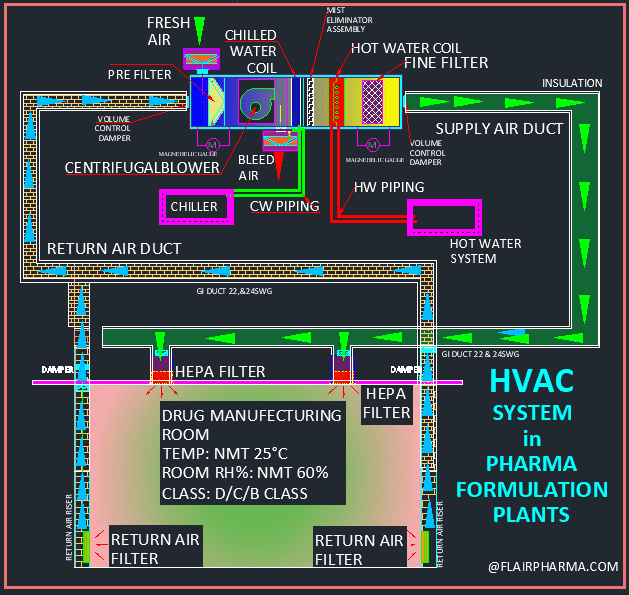
Consultant & Client
- Consultant: Flair Pharma Engineering Design Team
- Client: Flair Pharma Formulation Facility
Revision History
| Rev. No | Prepared By | Date | Checked By | Date | Issued For | Remarks |
|---|---|---|---|---|---|---|
| 00 | – | – | – | – | – | – |
Document Approval
Consultant Approval
| Name | Signature | Date |
|---|---|---|
| Prepared By | ||
| Checked By | ||
| Approved By |
Client Approval
| Sr. No. | Rev. No. | Approved By | Date | Approval Status |
|---|---|---|---|---|
| – | – | – | – | – |
Table of Contents
- Introduction
- Project Information
- Design Criteria
- Basis of Design
- Filtration Levels
- Airborne Particles & Environmental Grades
- Allocation of Air Handling Units (AHUs)
- Internal Loads
- Cooling/Heating Load Estimation
- Air Distribution System
- HVAC Equipment Specifications
- Utility Requirements
- AHU Design Parameters
- Documentation & Compliance
- Performance Testing
- Reference Standards
- Reference Drawings
- Abbreviations
1. Introduction
M/s. Flair Pharma is establishing an OSD Block, OSD Liquid Block, LAB Area, OSD Hormone Block, Utility pharmaceutical manufacturing facility in Panchkula, Haryana.
Key Features:
- Total Plot Area: ~20,000 sqm
- Building Configuration:
- OSD Block (EU GMP & USFDA Compliance)
- Hormone OSD Block (EU GMP & USFDA Compliance)
- OSD Liquid Block, (EU GMP & USFDA Compliance)
- Lab, Admin & Utility Blocks
- Construction: RCC-based structures
- Key Features of the Proposed Facility Layout
- Regulatory Compliance & Zoning
- The General OSD and Liquid Production Block is being designed in alignment with EU GMP guidelines to ensure quality compliance for global markets.
- The Hormone OSD Block is designed to meet both EU GMP and USFDA norms, considering stringent containment, environmental controls, and validation requirements for hormone-based product manufacturing.
- Controlled Entry Strategy
- A Two-Gate Cabin system is proposed for segregation of personnel and material movement:
- Staff Entry Gate: Includes security check, change room access, and biometric control.
- Material Entry Gate: With provision for de-dusting, inspection, and staging area.
- A Two-Gate Cabin system is proposed for segregation of personnel and material movement:
- Optimized Utility Planning
- Central Utility Block is strategically located to ensure:
- Short and efficient routing of services (piping, cabling, ducting) to all production and support blocks.
- Reduced energy losses and simplified maintenance access.
- The utility block houses:
- Chillers, Boilers, Air Compressors
- Water Pre-treatment System & Cooling Towers
- Transformer yard & HT Panel / Breaker Room
- Engineering office, maintenance store & workshop
- Future utility expansion provisions are incorporated with reserved land and service corridors within the plot layout.
- Central Utility Block is strategically located to ensure:
- Fuel Storage & Safety
- FO (Furnace Oil) and HSD (High-Speed Diesel) Tank Farm is planned adjacent to the utility block, ensuring:
- Proximity for uninterrupted boiler and generator operations
- Safety compliance with appropriate bund walls, venting, and fire protection systems.
- FO (Furnace Oil) and HSD (High-Speed Diesel) Tank Farm is planned adjacent to the utility block, ensuring:
- Water Storage & Fire Safety
- An underground domestic water tank is proposed alongside a dedicated fire water tank with:
- Adequate storage capacity as per NFPA norms.
- Dedicated pump room with jockey, main, and diesel engine-driven pumps.
- Fire hydrant and sprinkler loop access across the facility.
- An underground domestic water tank is proposed alongside a dedicated fire water tank with:
- Environmental & Hazardous Waste Management
- A Non-PESO (Petroleum and Explosives Safety Organization) Store is proposed for safe storage of regulated non-explosive materials.
- An Effluent Treatment Plant (ETP) is planned at the North-West corner, ensuring:
- Segregated collection from process drains
- Compliance with CPCB/SPCB discharge norms.
- Electrical Infrastructure
- A Four-Pole Structure and Metering Room are proposed at the North-East corner to facilitate:
- HT/LT power reception and distribution
- Energy monitoring and redundancy
- Space for future transformer addition
- A Four-Pole Structure and Metering Room are proposed at the North-East corner to facilitate:
- Parking & Circulation
- Open car parking bays are designated along the East side of the plot to:
- Accommodate employee and visitor vehicles
- Ensure smooth internal circulation for vehicular movement
- Separate logistics and personnel movement pathways
- Open car parking bays are designated along the East side of the plot to:
2. Project Information
Location & Ambient Conditions
- Site:
- Latitude:
- Altitude:
- Ambient Conditions (ISHRAE Data):
| Season | DBT (°F) | WBT (°F) | RH (%) |
|---|---|---|---|
| Summer | 101.7 | 74.5 | 28.5 |
| Monsoon | 91 | 82.8 | 71.31 |
| Winter | 34.5 | 34 | 95.4 |
3. Design Criteria
- ISPE Guidelines
- ASHRAE Standards
- ISO 14644 (Cleanroom Classification)
- SMACNA (Duct Construction Standards)
- WHO & EU/USFDA GMP Norms
4. Basis of Design
Lab Area
- Grade B/C/D AHUs (25°C, 60% RH, HEPA Filtration)
- Microbiology Labs: Dedicated Exhausts
OSD Block (Tablet and Liquid)
- Grade D AHUs (25°C, 60% RH)
- Warehouses: 6 ACPH
Hormone OSD Block
- BIBO Filtration (G4+H13)
- Pressure Cascading (15 Pa Differential)
Utility Block
- Ventilation & Comfort Cooling (27°C, Non-Classified)
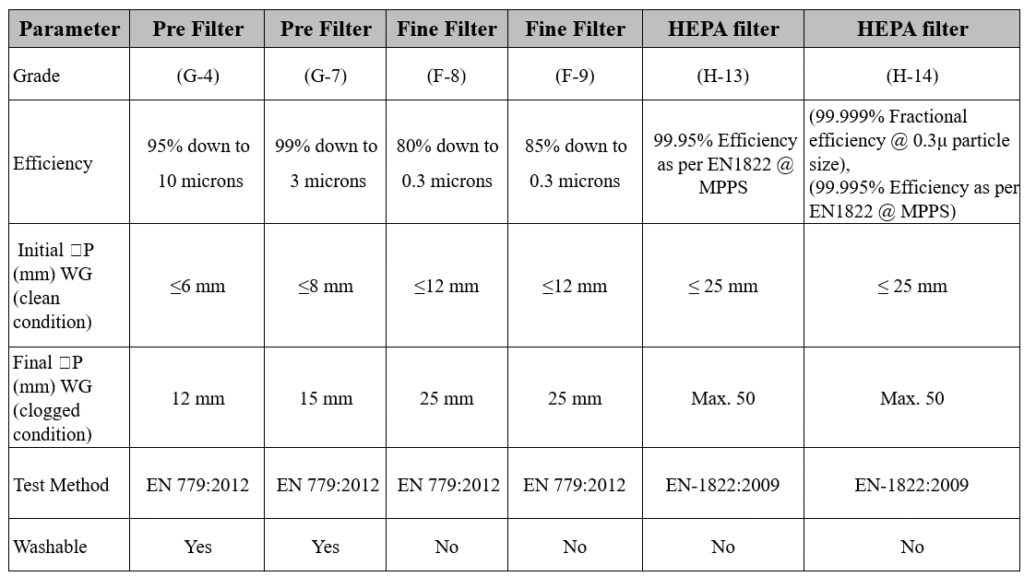
5. Filtration Levels
| Filter Type | Grade B | Grade C | Grade D | CNC Areas |
|---|---|---|---|---|
| Pre-Filter (G4) | ✔ | ✔ | ✔ | ✔ |
| Fine Filter (F8) | – | F9 | F8 | F8 |
| HEPA (H13/H14) | H13 | H13 | H13 | – |
| Area / AHU Type | Return Filter | Fresh Air Filter | Pre-Filter | Intermediate Filter | Fine Filter | Bleed Filter | Terminal Filter | Return Air BIBO Plenum | Exhaust Units |
|---|---|---|---|---|---|---|---|---|---|
| Grade B AHU (Lab Area) | G-4 | G-4 | G-4 + F-7 | – | H-13 | H-13 | H-14 | – | – |
| Grade C AHU (Lab Area) | G-4 | G-4 | G-4 + F-7 | – | F-9 | H-13 | H-14 | – | – |
| Grade D AHU (Lab Area – General Block) | G-4 | G-4 | G-4 | – | F-8 | H-13 | H-14 | – | – |
| Grade D AHU (Hormone Block) | G-4 | G-4 | G-4 | – | F-8 | H-13 | H-14 | G-4 + H-13 | – |
| CNC AHU (Hormone Block) | – | G-4 | G-4 | – | F-8 | F-8 | – | – | – |
| Ventilation Supply (All Blocks) | – | G-4 | – | – | F-7 | – | – | – | – |
| Ventilation Exhaust (All Blocks) | – | G-4 | – | – | – | – | – | – | G-4 |
| Exhaust & Sunk Module Unit (Lab/Utility/Gen) | – | G-4 | – | – | – | – | – | – | G-4 + H-13 |
Legend:
- G-4: Coarse Filter (Preliminary dust filtration)
- F-7 / F-8 / F-9: Fine Filters (Intermediate particle control)
- H-13 / H-14: HEPA Filters (High-Efficiency Particulate Air Filters)
- CNC: Controlled Not Classified
- BIBO: Bag-In Bag-Out (sealed containment filter system)
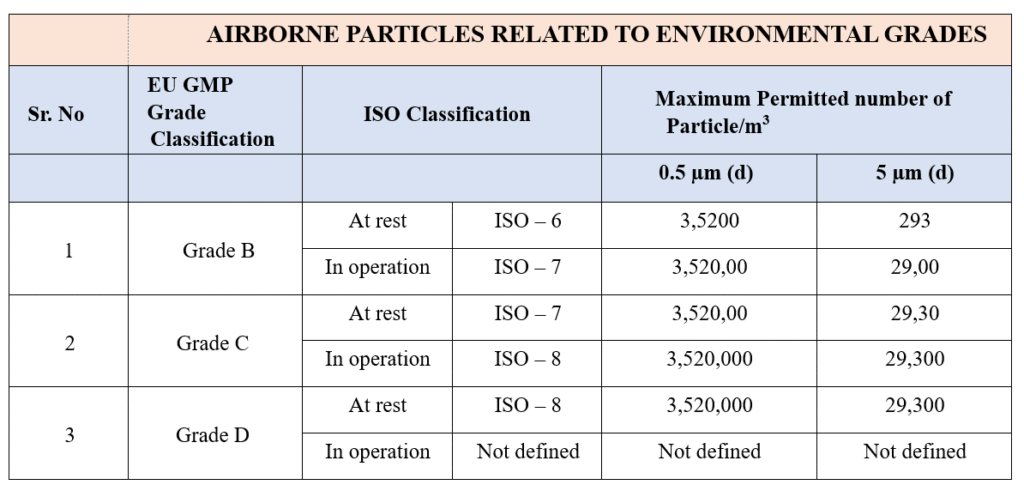
6. Airborne Particles (ISO 14644)
7. AHU Allocation Strategy
- Zoning: Based on temperature, humidity, and contamination control.
- Pressurization:
- Grade B → C → D → CNC (10–15 Pa gradient)
- Air Changes:
- Grade B: 60 ACPH
- Grade C: 40 ACPH
- Grade D: 20 ACPH
7.1 AHU Zoning Strategy
The zoning and allocation of AHUs have been meticulously planned based on the following critical parameters:
- Environmental Requirements: Specific temperature and relative humidity (RH) requirements within each room or area.
- Functional Workflow: The nature of operations and functionality of each room, such as dispensing, sampling, packing, storage, etc.
- Contamination Control: Strategic zoning is done to minimize the risk of cross-contamination between areas of different cleanliness classifications.
- Process Segregation: Logical separation of clean and unclean areas based on product and personnel flow.
Each AHU is dedicated to a defined zone to support efficient environmental control, operational integrity, and GMP compliance.

7.2 Room Pressurization & Airflow Design
The HVAC system is designed with a unidirectional airflow strategy to ensure optimal environmental control and prevent particulate ingress:
- Airflow Direction: Maintained from higher-grade clean areas to lower-grade or unclassified zones to uphold cleanliness integrity.
- General Flow Principle: Air movement is designed to be from cleaner areas (e.g., production zones) to relatively unclean areas (e.g., corridors, service zones).
- Positive Pressure Corridors: Process corridors will be positively pressurized with respect to adjoining rooms to act as a buffer and prevent backflow.
- Pressure Gradient Logic: Differential pressures are established to confine any potential contamination within designated process areas.
Pressure Differential Guidelines:
| Between Areas | Required Differential Pressure |
|---|---|
| Between rooms of same cleanliness class | Minimum 10 Pa |
| Between rooms of different cleanliness classes | Minimum 15 Pa |
Note: All pressure differentials shall be monitored and maintained using calibrated Magnehelic gauges or differential pressure transmitters.
7.3 Minimum Supply Air Changes (ACPH) per Area Classification
To ensure consistent environmental quality, AHUs are designed to deliver the following minimum air changes per hour (ACPH) as per ISO/GMP guidance:
| Area Classification | Minimum ACPH Requirement |
|---|---|
| Grade D | 20 ACPH |
| Grade C | 40 ACPH |
| Grade B | 60 ACPH |
| CNC (Controlled Non-Classified) | 10 ACPH |
| Warehousing / Packing / Stores | 6 ACPH |
Note:
The final ACPH will be fine-tuned based on dehumidified supply air volume (CFM) derived from heat load analysis during detailed engineering. These calculations will consider occupancy, equipment load, lighting load, infiltration, and process requirements.
8. Internal Loads
- Lighting: 2 W/sqft
- Equipment Heat Load: As per process requirements
- Occupancy: 15 CFM/person (ASHRAE 62.1)
- Fresh Air: Max of 15 CFM/person or pressure gradient needs
INTERNAL HEAT LOAD CONSIDERATIONS in Design Basis Document of HVAC
Proper estimation of internal loads is vital to designing an efficient HVAC system. The internal loads consist of:
Lighting Load
- Lighting heat gain shall be estimated based on illuminance (lux) levels prescribed for pharmaceutical manufacturing areas.
- For HVAC preliminary calculations, a lighting load of approximately 2 W/sqft is assumed. However, this will be revalidated based on actual lux level specifications (e.g., 300–500 lux for production; 150–200 lux for corridors).
- Reference: ISHRAE Handbook / IS 3646 for industrial lighting norms.
Equipment Load
- Equipment heat loads will be considered based on actual power ratings, duty cycles, and equipment specifications obtained from the process equipment datasheets.
- Heat dissipation data will include both radiative and convective heat contributions from machinery and control panels operating within each area.
Occupancy Load
- Occupancy levels shall be considered as per the approved Room Data Sheets.
- Light work activity level (as per ASHRAE standards) shall be used to estimate the sensible and latent heat load generated by each occupant for HVAC sizing purposes.
Fresh Air Requirement
Fresh air ventilation rates shall be designed based on the maximum value among the following guidelines, ensuring both indoor air quality and pressure balancing:
| Reference Standard | Fresh Air Requirement |
|---|---|
| ASHRAE 62.1 (General Pharma Areas) | 15 CFM/person + 0.18 CFM/sq.ft. |
| ASHRAE 62.1 (Warehouses & Storage) | 15 CFM/person + 0.06 CFM/sq.ft. |
| ISHRAE Guidelines | 23 CFM/person |
| HVAC Engineering Design (System Balance) | As required to maintain pressure gradients through compensation for infiltration, exfiltration, and exhaust airflow. |
Door Gap Leakage Estimation
Air leakage between rooms due to pressure differentials shall be accounted for using standard gap dimensions per door type:
| Door Section | Typical Gap for Leakage Calculation |
|---|---|
| Bottom of Door | 6 mm |
| Sides, Top, and Center (Double Leaf Doors) | 1.5 mm each |
These values are critical in assessing air infiltration and exfiltration rates used in load and pressure differential calculations.
Additional Design Considerations
- External Walls: Considered uninsulated with a U-value of 0.36 BTU/sq.ft/°F, wherever applicable.
- RCC Slabs (Roof): U-value shall also be 0.36 BTU/sq.ft/°F, as applicable.
- False Ceiling Panels: Modular panels with 50/80 mm thickness, having a U-value of 0.20 BTU/sq.ft/°F.
- Dedicated AHUs: All classified process areas shall be served by independent AHUs to prevent cross-contamination and ensure precise environmental control.
- Room Condition Compliance: All areas must reach validated temperature and RH conditions prior to the start of operations.
- Electrical Panel Location: AHU starter panels shall be positioned close to the respective AHUs in the service corridor. Power incomers shall be provided by the Client or designated Electrical Contractor.
- Fire Safety: Fire dampers with fusible links shall be installed at both supply and return ducts of each AHU, in compliance with fire safety standards.
- Exhaust Management: All bleed and exhaust air from AHUs and rooms shall be vented into the service floor.
- Bleed Air CFM: Indicative values are based on preliminary design assumptions and may be revised during system commissioning and balancing.
- Fan Type & Control: All AHUs and ventilation systems shall be equipped with plug-type fans controlled via Variable Frequency Drives (VFDs) for operational flexibility and energy efficiency.
9. Cooling/Heating Load Estimation
- Chilled Water: 7°C (Inlet), 12°C (Outlet)
- Hot Water: 50°C (Inlet), 42.5°C (Outlet)
- DX Units: PET Bottle Area (Standby Cooling)
10. Air Distribution System
- Supply: Terminal HEPA (Grade B/C/D), Diffusers (CNC)
- Return: Low-level risers (G4 filters)
- Exhaust: Dedicated for washrooms, solvent areas
11. HVAC Equipment Specifications
- AHUs: Double-skinned, VFD-driven plug fans
- Ducting: SMACNA-compliant, leak-tested
- Filters: HEPA (99.999% @ 0.3µm)
- Insulation: Nitrile rubber (19mm for supply, 13mm for return ducts)
12. Utility Requirements
- Power: 415V, 50Hz
- Chilled Water: 7–12°C
- Compressed Air: 6 bar
- Hot Water : 42 to 50°C
13. AHU Design Parameters
| Parameter | Value |
|---|---|
| Filter Face Velocity | ≤500 FPM |
| Coil Face Velocity | ≤450 FPM |
| HEPA Velocity | ≤200 FPM |
| Duct Pressure Drop | ≤10 mm WG |
14. Documentation & Compliance
- DQ/IQ/OQ/PQ Reports
- SMACNA Duct Testing
- HEPA Integrity Tests
15. Performance Testing
- Airflow Visualization (Smoke Test)
- Room Pressure/Temperature/RH Mapping
- Particle Count (ISO 14644)
16. Reference Standards
- ASHRAE, ISPE, ISO, SMACNA, WHO
17. Reference Drawings
- AHU Zoning, Pressure & Classification Diagrams
18. Abbreviations
| Term | Definition |
|---|---|
| DBT | Dry Bulb Temperature |
| ACPH | Air Changes Per Hour |
| FLP | Flame Proof |
| NFLP | Non-Flame Proof |
This document ensures compliance with GMP, ASHRAE, and ISO standards while maintaining energy efficiency and contamination control.
NOTE: HVAC Design Considerations & Clarifications
- Exhaust Systems
- All exhaust air rates must be explicitly mentioned, and respective reference standards or design bases should be clearly cited.
- Dedicated exhaust systems are considered for:
- Wash areas
- Hot zones
- Primary Change Room lockers
- Standby DX Coil in AHUs for 24×7 Operations
- For rooms operating continuously (24 hours), a standby DX coil is to be installed in the AHU downstream of the chilled water coil.
- The DX coil will operate only during chiller shutdown conditions.
- Temperature control will be maintained in DX mode; however, relative humidity (RH) will not be controlled.
- Motor Suitability: Ensure AHU fan motors and compressors used in DX systems are rated and designed for 24×7 continuous operation. Check for VFD compatibility, duty cycles, and manufacturer recommendations for longevity and efficiency.
- Temperature & Humidity Control
- Temp and RH setpoints are defined as per specific process requirements.
- For administrative and office areas, comfort conditions are considered.
- Low Ambient Humidity Scenario:
- Clarification required on how RH will be maintained during low ambient conditions—consider use of steam injection humidifiers, spray-type humidifiers, or adiabatic humidification systems where necessary.
- RH control should be validated during both summer and winter cycles.
- UPS & Battery Rooms
- These rooms are provided with dedicated high-wall mounted DX split units (standby configuration).
- Ensure continuous cooling to maintain equipment safety and battery efficiency.
- General Area
- Currently operating on DX-based AHUs.
- Recommendation: Replace with Precision Air Conditioning (PAC) units for better temperature control, energy efficiency, and reliability under varying loads.
- Rooms with Standby DX Provision for 24×7 Use
- The following rooms are equipped with DX systems for standby operation:
- OSD & OSD Hormone Block:
- RM & FG Warehouses
- Dispensed Material Room, Blend IPS, IPS Tablet Room
- OSD & OSD Hormone Block:
- The following rooms are equipped with DX systems for standby operation:
- Positive Pressure Zones
- Rooms such as:
- Change Parts Store
- Clean Equipment Storage
- Spare Parts Room
- Dies & Punch Polishing & Storage
- Granulation Spares Room
- Spare Equipment Room
- Compression Coating Change Parts Room
- These are to be maintained at positive pressure relative to adjacent corridors to prevent ingress of contaminants.
- Rooms such as: