
Ensure precise and safe chemical preparation in pharmaceutical water systems with optimized dosing, contamination control, and compliance with GMP standards—enhancing water quality, system efficiency, and product integrity.
🧪 Chemicals Used & Their Purpose
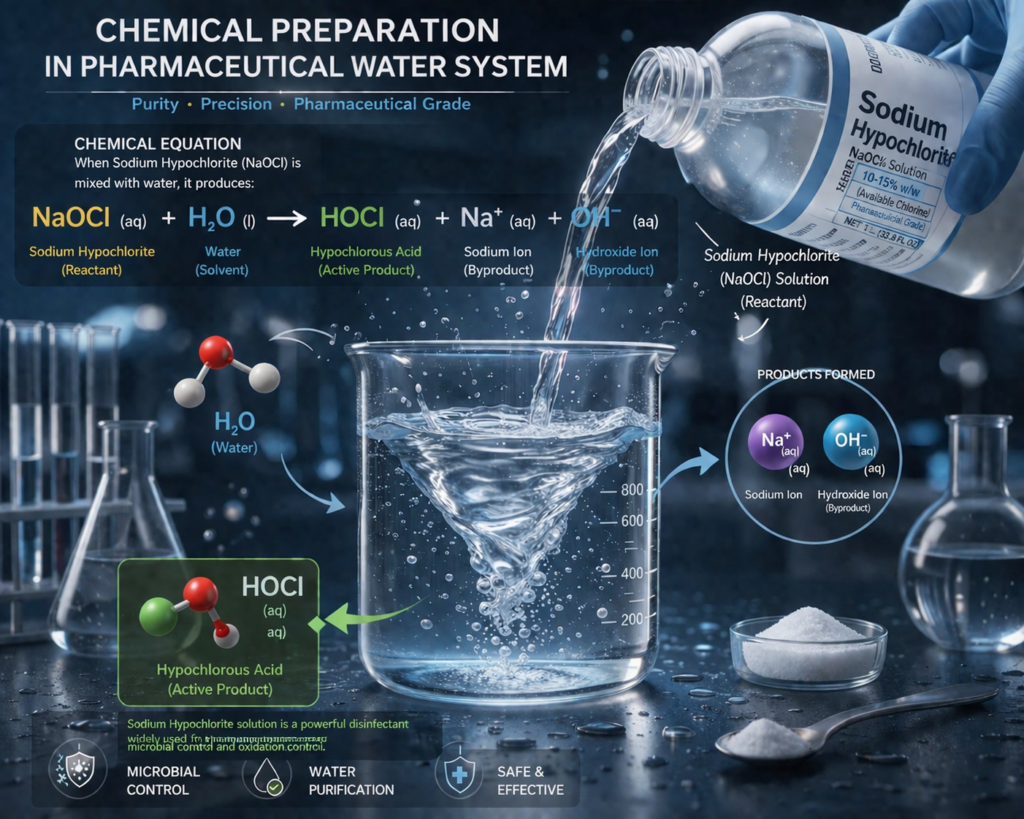
🧪NaOCl (Sodium Hypochlorite)
👉Used for disinfection and microbial control
🧪SMBS (Sodium Metabisulfite)
👉Used for dechlorination (removes chlorine before RO membranes)
🧪NaOH (Sodium Hydroxide)
👉pH Adjustment & Carbon Dioxide Removal
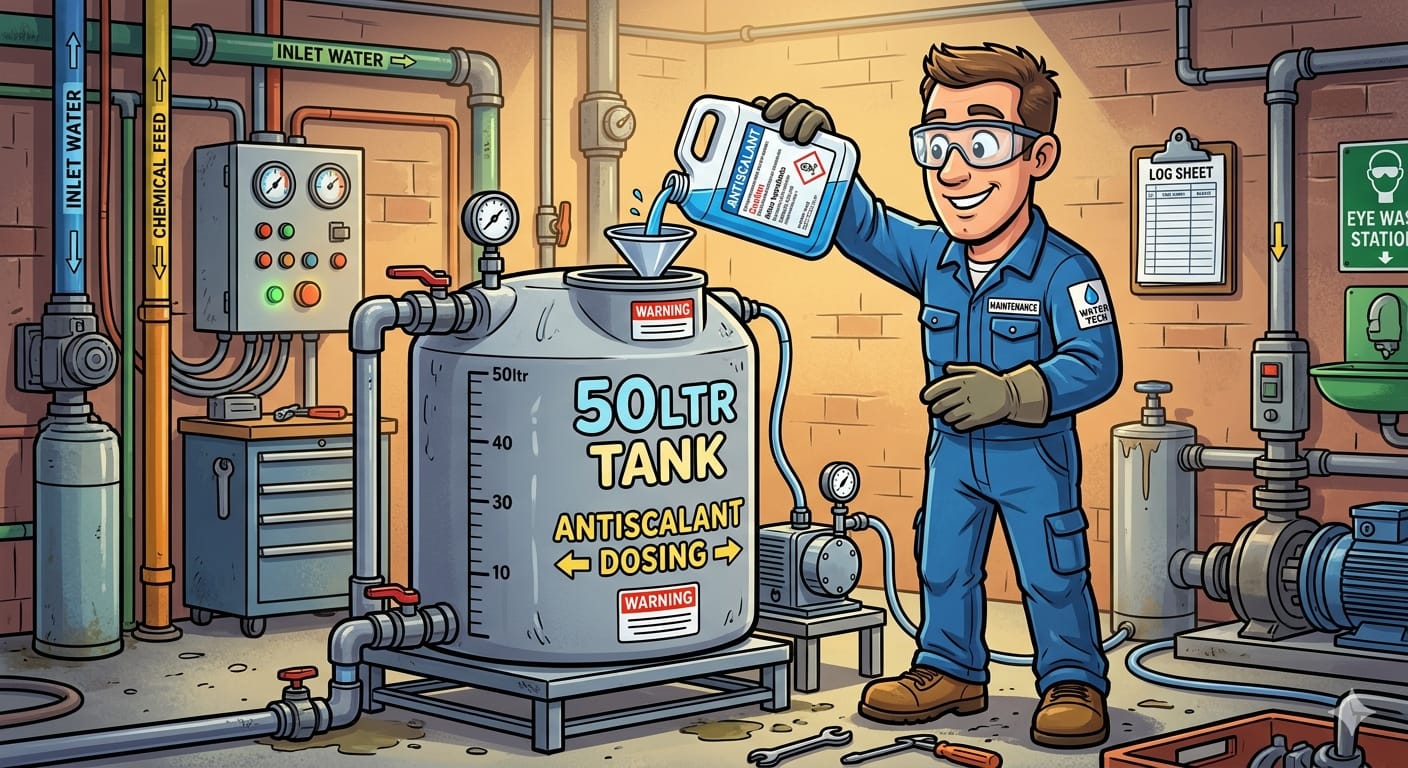
🧪Antiscalant
👉Prevents scaling on RO membranes (like calcium deposits)
🌊 How Each Chemical Improves Pharmaceutical Water
“Ever wondered how pharmaceutical water stays pure and safe for life-saving products? True understanding comes when you know why things work, not just how to calculate them.
If you want to build strong, practical concepts that make sense in real-world systems, take a few minutes to dive into the full explanation below.
But if your goal is quick application, no worries—you can skip ahead straight to the formula section and start working with the values. Either way, understanding these basics will make your work smarter and more effective.
🧪 1. Sodium Hypochlorite (NaOCl) – Disinfection
👉 What it does:
It works like a sanitizer for water. Kills bacteria, viruses, and other microorganisms.
👉 How it works: When NaOCl is added to water, it forms hypochlorous acid (HOCl), which is a strong disinfectant.
⚗️ Reaction:
NaOCl + H₂O → HOCl + NaOH
HOCl → H⁺ + OCl⁻
HOCl penetrates microbial cells and destroys them from inside.
🧪 2. SMBS (Sodium Metabisulfite) – Dechlorination
👉 What it does:
Removes chlorine before water enters RO membranes. It protects RO membranes by removing chlorine from water.
👉 How it works:
SMBS reacts with chlorine and neutralizes it.
⚗️ Reaction:
Na₂S₂O₅ + H₂O → 2 NaHSO₃
NaHSO₃ + Cl₂ → NaHSO₄ + HCl
👉 What happens here?
- Na₂S₂O₅ (SMBS) reacts with water.
- It breaks down into sodium bisulfite (NaHSO₃)
SMBS itself is not directly active. When it is added to water, it converts into bisulfite, which is the actual working chemical.
NaHSO₃ (bisulfite) reacts with chlorine (Cl₂)
Chlorine gets converted into harmless compounds:
- NaHSO₄ (sodium bisulfate)
- HCl (hydrochloric acid in dilute form)
Simply put – When we add SMBS to water, it first forms bisulfite. This bisulfite then reacts with chlorine and neutralizes it, converting it into harmless compounds. This step is very important to protect RO membranes from damage.
🧪 3. Sodium Hydroxide (NaOH) – pH Adjustment & Carbon Dioxide Removal
👉 What it does:
Increase pH (makes water less acidic) and removes dissolved CO₂
👉 How it works:
Adding NaOH removes dissolved carbon dioxide by converting it into sodium carbonate (Na₂CO₃).
This sodium carbonate is then removed by RO membrane.
⚗️ Reaction:
CO₂ + 2 NaOH → Na₂CO₃ + H₂O
Dosing NaOH before the RO membrane allows it to remove CO₂ and protect the membrane. Dosing after RO only adjusts pH. When we add NaOH to water, it doesn’t just adjust pH—it reacts with dissolved carbon dioxide and removes it. This prevents the formation of carbonic acid, protects RO membranes, and keeps the water system running safely.
🧪 4. Antiscalant – Scale Prevention
👉 What it does:
Prevents formation of hard deposits (like calcium carbonate) on RO membranes. Antiscalant keeps the system clean by preventing scale buildup
👉 How it works:
Antiscalant interfere with crystal formation and keep salts dissolved. Antiscalant blocks the Crystal growth thus leads to no scale formation.
⚗️ Reaction Without Antiscalant:
Ca²⁺ + CO₃²⁻ → CaCO₃ ↓ (scale formation)
When calcium ions in water react with carbonate ions, they form calcium carbonate, which is a solid. This solid does not dissolve in water and starts settling or sticking to surface.
🎯Alright, now that we’ve covered the chemical, let’s move on to preparing the solution accurately. Chemical preparation for solution shall be calculated as per below formula:
👉Require Dosing Flow Rate = (Water Flow rate in LPH * Required Dosage in ppm) / (Concentration of solution in Dosing Tank in ppm)
👉Require Quantity of Solution prepare per day = (Dosing Flow Rate × Operating Hours per day) + Tank Dead Volume
(Dead volume – Extra solution that remains unused in the tank due to tank design)
👉Quantity of Chemical required in Liters. = (Quantity of Dosing Solution to be prepared in Liters * Concentration of Dosing Solution into the tank in %) / (Standard Concentration of Chemical available in %)
👉Water to be added in Dosing Solution = (Quantity of Dosing Solution to be prepared in Liters) – (Quantity of Chemical to be used in liters)
Let’s understand this with a real example—it’ll make everything crystal clear.
Suppose we have the following data:
- Water Flow rate = 15000 LPH
- Required Dosage = 3 PPM
- Concentration of solution in Dosing Tank = 1%
- Operating Hours = 10
- Standard Concentration of Chemical available = 6%
- Tank Dead Volume = 15 Ltr
👉Step-1
Require Dosing Flow Rate = 15000*3 /1*10000 = 4.5 LPH
PPM = Percentage (%)×10,000
👉Step-2
Require Quantity of Solution prepare per day = 4.5*10+15 = 60 Liters
👉Step-3
Quantity of Chemical required in Liters = 60*1/6 = 10 Liters
👉Step-4
Water to be added in Dosing Solution = 60-10 = 50 Liters
And that’s how easily you can calculate your complete chemical dosing solution!
Got questions? Don’t hesitate to contact us—we’ll make sure all your doubts are cleared and you leave with a complete understanding.
Keep up the great work.